


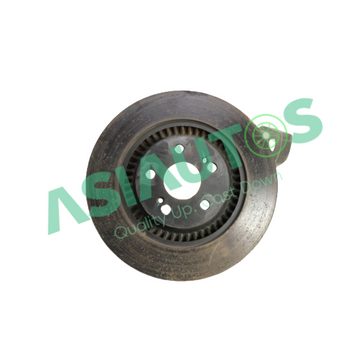
For hardcore off-road vehicles, the reliability of the braking system is directly related to driving safety in extreme road conditions. As a model focused on off-road performance, the JETOUR T2's front brake discs, front brake calipers, front brake pads, and vacuum booster are designed not only to meet the smooth demands of urban commuting but also to be optimized for off-road use, maintaining stable performance in high-temperature, high-load, and dusty conditions.
Front Brake Discs: A "Heat-Resistant Pioneer" in Off-Road Conditions

The JETOUR T2's front brake discs feature a ventilated, grooved design, a hallmark of hardcore off-road vehicles. With a diameter of 330mm and a thickness of 28mm, they are 10%-15% larger than those of typical urban SUVs. This larger size increases the heat dissipation surface by over 30%, quickly dissipating heat generated during braking and preventing "fading" (a sudden decrease in braking performance) on long downhill slopes or during continuous braking.
The discs are made of a high-strength cast iron alloy with added carbon and silicon, achieving a hardness of HB200-220 and offering 25% greater wear resistance than ordinary cast iron. The key feature is its ventilation structure: 36 spiral ventilation channels are located within the disc body. As the wheel rotates, air flows through these channels at high speed, creating a "natural air cooling" effect. Combined with the surface's scoring design—three evenly spaced circular grooves—they not only scrape away dust and debris from the brake pad surface, keeping the friction surface clean, but also quickly drain water after wading through water, preventing the "water film effect" that can cause slippage.
For off-road use, engineers have specially treated the brake discs: a 5mm-high dust guard is added to the edge to reduce the ingress of mud, sand, and debris into the brake clearance; and the disc surface is carbonized to form a harder oxide layer, reducing wear under extreme conditions. On continuous downhill mountain roads or rocky terrain, these brake discs maintain a consistent friction coefficient, providing reliable deceleration.
Front Brake Caliper: The "Force Performer" Under Heavy Loads

The front brake caliper is the "power center" of the braking system. The Jetour T2 utilizes a four-piston fixed caliper design, a rare feature among off-road vehicles in its class. Compared to the more common single-piston floating caliper, the four-piston caliper distributes braking force more evenly across the brake pads, reducing localized wear. It also improves braking response by 40%, enabling faster disc engagement during emergency braking.
The caliper housing is constructed from forged aluminum alloy and undergoes a T6 heat treatment process. This delivers 30% greater strength than cast aluminum while being 20% lighter. This effectively reduces unsprung mass (unsprung weight near the wheels) and enhances vehicle handling. The caliper body is anodized to create a corrosion-resistant protective film, preventing rust even in muddy or salty environments.
The four-piston layout is precisely calculated: the two inner pistons have a diameter of 38mm, and the two outer pistons have a diameter of 32mm. This "larger inner, smaller outer" design allows the brake pads to more closely conform to the curvature of the brake disc during clamping, preventing uneven wear. The seals inside the caliper are made of high-temperature fluororubber, capable of withstanding temperatures of up to 180°C. Even when the caliper heats up due to continuous braking, they maintain their seal and prevent brake fluid leakage. Furthermore, the caliper is equipped with a metal dust boot to prevent mud and sand from entering the piston clearance, ensuring long-term reliability in off-road conditions.
Front Brake Pads: The "Stability" of Friction Performance

The interaction between the front brake pads and the brake disc directly determines braking performance. The front brake pads of the Jietu T2 utilize a semi-metallic ceramic composite formula, which offers both wear and heat resistance, making it ideal for off-road use. The friction material contains 30% copper fibers and 20% ceramic particles. The copper fibers enhance friction coefficient stability at high temperatures, while the ceramic particles reduce noise and dust during braking.
The brake pad's steel backing is made of high-strength cold-rolled steel, 4mm thick, and undergoes an electrophoretic rust-proofing treatment, offering corrosion resistance far exceeding that of standard paint finishes. An elastic buffer layer, composed of high-temperature-resistant rubber and metal mesh, is placed between the steel backing and the friction material to absorb braking vibrations and reduce brake squeal. The brake pad's friction surface reaches 180cm², 20% larger than that of a typical SUV. This larger contact area distributes pressure and extends its service life—up to 60,000 kilometers in urban driving and over 40,000 kilometers in off-road driving.
To alert users to timely replacement, the brake pad features a built-in wear alarm. When the friction material thickness is less than 3mm, the pad will produce a "squeaking" sound when in contact with the brake disc. This eliminates the need for electronic sensors and is more reliable in dusty off-road environments. Furthermore, the friction material surface is chamfered to reduce cold braking noise (immediately after starting), ensuring both off-road practicality and everyday driving comfort.
Vacuum Booster: A "Force Amplifier" for Extreme Environments

The vacuum booster is a key component connecting the brake pedal to the brake master cylinder. Its function is to amplify the driver's pedal force, making off-road braking easier. The Jetour T2's vacuum booster has a diameter of 200mm, 15% larger than that of a typical SUV. Its boost ratio is 6:1 (the driver applies 1N of force, and the booster outputs 6N), ensuring a light brake pedal feel even when climbing at low speeds or under heavy loads.
The booster's internal dual-diaphragm structure provides improved sealing and 50% higher vacuum retention than a single-diaphragm design. In the event of a sudden engine stall while off-roading (an extreme situation), the reserve vacuum can still support two to three effective braking operations, giving the driver time to react. The booster's vacuum source comes not only from the engine's intake manifold but also from an electric vacuum pump. If insufficient vacuum is detected (e.g., during extended idling or frequent braking), the electric pump automatically activates to replenish vacuum, ensuring sufficient braking in all conditions.
To adapt to off-road conditions, the booster housing is constructed of corrosion-resistant cast iron, and the seals at the interfaces are made of nitrile rubber, offering excellent oil and temperature resistance. A dust cover is installed at the connection between the booster and the brake master cylinder to prevent mud and sand from intruding and affecting the push rod movement. Under extreme temperature testing ranging from -40°C to 80°C, the booster system maintained stable performance, meeting the demands of use in complex environments such as high altitude, severe cold, and scorching heat.
The four braking components of the Jetour T2 appear independent but work in tandem: the front brake discs and pads provide frictional deceleration, the front brake calipers provide clamping force, and the vacuum booster amplifies operating force, forming a braking system that adapts to all scenarios. Whether it's smooth braking on urban roads or steep slope descents and emergency braking off-road, this system, with its reinforced materials, optimized structure, and redundant design, provides the driver with a flexible braking experience, making it an essential safety feature for hardcore off-roading. For adventurous users, such braking performance is more than just a technical specification; it provides the confidence to explore the unknown.
ASIAUTOS.NETAUT
Your reliable supply partner for JETOUR T2 auto parts


