


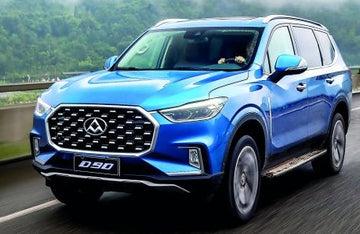
In the hardcore SUV market, MAXUS/LDV D90 has occupied a place with its powerful off-road performance and unique product charm. With the rapid development of automobile technology and the continuous changes in market demand, this classic model is also evolving in multiple directions, showing a clear development trend.
Powertrain: Powerful and environmentally friendly

As a hardcore off-road vehicle, power is the core competitiveness of the D90, and the future power system will find a better balance between strong output and environmental protection requirements. The 2.0T turbocharged engine currently equipped with the D90 has excellent power performance, but there will be further upgrades in the future.
On the one hand, traditional fuel power will continue to be optimized. By improving turbocharging technology and improving fuel injection accuracy, the thermal efficiency of the engine can be improved, and fuel consumption and exhaust emissions can be reduced while ensuring that the maximum power and torque are not reduced. For example, the use of a twin-scroll turbocharger can reduce exhaust interference, make the turbine respond faster, and the power output smoother, while improving fuel economy.
On the other hand, new energy power will gradually penetrate. The hybrid system will be an important transitional solution, adding electric motor auxiliary drive while retaining the strong power of the fuel engine. In this way, the pure electric mode can be used for urban commuting to reduce fuel consumption; when off-road, the engine and the motor work together to burst out stronger power to cope with complex road conditions. In the long run, a pure electric version is not impossible. With the advancement of battery technology, high-capacity, fast-charging battery packs can provide the D90 with sufficient range. The instantaneous high torque characteristics of the motor are also very suitable for off-road scenarios. Combined with an efficient energy recovery system, the pure electric D90 can open up new horizons in the off-road field.
On the one hand, traditional fuel power will continue to be optimized. By improving turbocharging technology and improving fuel injection accuracy, the thermal efficiency of the engine can be improved, and fuel consumption and exhaust emissions can be reduced while ensuring that the maximum power and torque are not reduced. For example, the use of a twin-scroll turbocharger can reduce exhaust interference, make the turbine respond faster, and the power output smoother, while improving fuel economy.
On the other hand, new energy power will gradually penetrate. The hybrid system will be an important transitional solution, adding electric motor auxiliary drive while retaining the strong power of the fuel engine. In this way, the pure electric mode can be used for urban commuting to reduce fuel consumption; when off-road, the engine and the motor work together to burst out stronger power to cope with complex road conditions. In the long run, a pure electric version is not impossible. With the advancement of battery technology, high-capacity, fast-charging battery packs can provide the D90 with sufficient range. The instantaneous high torque characteristics of the motor are also very suitable for off-road scenarios. Combined with an efficient energy recovery system, the pure electric D90 can open up new horizons in the off-road field.
Smart off-road: technology empowers complex road conditions

Hardcore off-road is no longer a "physical job" that relies solely on driver experience. Intelligent technology is becoming an important boost for D90 to improve its off-road capabilities.
The intelligent four-wheel drive system will be more advanced. It will monitor the vehicle status and road conditions (such as slope, adhesion, etc.) in real time through multiple sensors, automatically adjust the torque distribution ratio of the front and rear axles, and even brake a certain wheel separately to help the vehicle get out of trouble smoothly in complex road conditions such as mud, climbing, and cross-axle. For example, when the system detects that a wheel is slipping, it will quickly brake it and transfer power to the wheel with adhesion. The whole process does not require manual operation by the driver, which greatly reduces the threshold of off-road.
Intelligent driving assistance will also have new applications in off-road scenarios. In addition to the common steep slope descent function, an automatic off-road mode may also be added. The vehicle can automatically control the throttle, brake and steering according to the terrain, so that inexperienced drivers can also safely pass some difficult off-road sections. At the same time, the 360-degree panoramic imaging system will be upgraded, combined with AR technology, to display the terrain data and wheel tracks around the vehicle in real time, so that the driver can more intuitively understand the distance between the vehicle and obstacles and avoid collisions.
The intelligent four-wheel drive system will be more advanced. It will monitor the vehicle status and road conditions (such as slope, adhesion, etc.) in real time through multiple sensors, automatically adjust the torque distribution ratio of the front and rear axles, and even brake a certain wheel separately to help the vehicle get out of trouble smoothly in complex road conditions such as mud, climbing, and cross-axle. For example, when the system detects that a wheel is slipping, it will quickly brake it and transfer power to the wheel with adhesion. The whole process does not require manual operation by the driver, which greatly reduces the threshold of off-road.
Intelligent driving assistance will also have new applications in off-road scenarios. In addition to the common steep slope descent function, an automatic off-road mode may also be added. The vehicle can automatically control the throttle, brake and steering according to the terrain, so that inexperienced drivers can also safely pass some difficult off-road sections. At the same time, the 360-degree panoramic imaging system will be upgraded, combined with AR technology, to display the terrain data and wheel tracks around the vehicle in real time, so that the driver can more intuitively understand the distance between the vehicle and obstacles and avoid collisions.
Personalized custo mization: meeting diverse needs

D90 has always been outstanding in terms of personalized customization, and this feature will be more prominent in the future. From the appearance point of view, consumers will have more body colors, grille styles, wheel sizes and styles to choose from, and can even customize exclusive body decals to make their D90 unique.
In terms of interior, personalized options will also be more abundant. In addition to the common leather, the seat material may also provide more wear-resistant fabric or Alcantara material; the interior color can be matched according to personal preferences, from calm dark colors to lively bright colors; the seat layout is also more flexible. In addition to the common 5-seat and 7-seat, 6-seat or 4-seat layouts can be customized according to needs to meet the needs of different families or off-road teams.
In terms of functional configuration, a modular design will also be adopted. Consumers can choose whether to add front winches, roof racks, off-road bumpers and other equipment according to their actual needs, which not only avoids unnecessary cost expenditures, but also makes the vehicle more suitable for personal use scenarios.
In terms of interior, personalized options will also be more abundant. In addition to the common leather, the seat material may also provide more wear-resistant fabric or Alcantara material; the interior color can be matched according to personal preferences, from calm dark colors to lively bright colors; the seat layout is also more flexible. In addition to the common 5-seat and 7-seat, 6-seat or 4-seat layouts can be customized according to needs to meet the needs of different families or off-road teams.
In terms of functional configuration, a modular design will also be adopted. Consumers can choose whether to add front winches, roof racks, off-road bumpers and other equipment according to their actual needs, which not only avoids unnecessary cost expenditures, but also makes the vehicle more suitable for personal use scenarios.
Body and chassis: lighter, stronger and more comfortable

The upgrade of body materials is an important trend. D90 will use more high-strength steel and aluminum alloy materials, and even use carbon fiber composite materials on some parts. The application of these materials can significantly reduce the weight of the body while ensuring the rigidity of the body, which can not only improve the power performance and fuel economy, but also make the vehicle more flexible when off-road.
Chassis technology will also continue to be optimized, and the suspension system will adopt more advanced structures, such as adaptive air suspension. This suspension can automatically adjust the height and hardness according to the road conditions, lower the height of the body when driving on the road, reduce wind resistance, and improve handling; raise the body when off-road, increase ground clearance, and improve passability. At the same time, the suspension adjustment will be more refined, while filtering road bumps and ensuring ride comfort, retaining enough road feel, so that the driver can better judge the vehicle status.
The development trend of MAXUS/LDV D90 not only continues its core gene of hard-core off-road, but also incorporates contemporary elements such as environmental protection, intelligence, and personalization. These evolutions can not only enable it to maintain its advantage in the fierce market competition, but also bring consumers a better and more diverse off-road experience, so that the charm of hard-core off-road can be better displayed in the new era.
Chassis technology will also continue to be optimized, and the suspension system will adopt more advanced structures, such as adaptive air suspension. This suspension can automatically adjust the height and hardness according to the road conditions, lower the height of the body when driving on the road, reduce wind resistance, and improve handling; raise the body when off-road, increase ground clearance, and improve passability. At the same time, the suspension adjustment will be more refined, while filtering road bumps and ensuring ride comfort, retaining enough road feel, so that the driver can better judge the vehicle status.
The development trend of MAXUS/LDV D90 not only continues its core gene of hard-core off-road, but also incorporates contemporary elements such as environmental protection, intelligence, and personalization. These evolutions can not only enable it to maintain its advantage in the fierce market competition, but also bring consumers a better and more diverse off-road experience, so that the charm of hard-core off-road can be better displayed in the new era.
ASIAUTOS.NETAUT
Your reliable supply partner for MAXUS/LDV D90 auto parts
Your reliable supply partner for MAXUS/LDV D90 auto parts


