


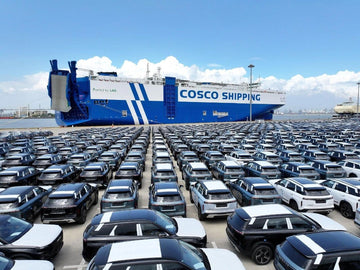

From a mere 4% share of exports in 2020 to one in every five vehicles produced being exported today, exports have become the fastest-growing sector in China's auto industry over the past five years.
The changes aren't limited to volume.
Data from the China Association of Automobile Manufacturers (CAAM) show that in the first half of this year, China exported 3.083 million vehicles, a year-on-year increase of 10.4%. While the growth rate has slowed, the rankings of individual automakers and the performance of different regional markets reveal even more intense changes and competition than in the domestic market.
With domestic market penetration exceeding 50% for consecutive years, China's new energy vehicles (NEVs) continue to expand overseas. In the first half of the year, new energy vehicle exports increased by over 75% year-on-year. Meanwhile, while gasoline-powered vehicles remain the main export force, their total volume declined by 7.5%.
Specifically for exporting companies, after maintaining the top sales position in the domestic market for two consecutive years, BYD has also begun to rapidly expand into overseas markets. In the first half of this year, it not only achieved the highest overseas sales among domestic brands, but also surpassed Tesla in the European market for the first time.
Leveraging new energy vehicles, Chinese automakers are extending their influence to the global market. Of course, changes in the overseas market are also impacting Chinese automakers.
Looking at the export performance of various automakers in the first half of the year, many experienced a decline, primarily due to the impact of the Russian market. Two years ago, Russia was China's largest auto export market, driving China's leapfrogging of Japan to become the world's largest auto exporter. However, this year, nearly all Chinese automakers have seen declines of over 20% in this market. Instead, exports to regions like Central and South America and the Middle East have continued to rise.
In short, China's auto exports not only achieved record sales in the first half of the year, but also saw significant changes in various rankings compared to previous years, driven by new energy vehicles.
BYD surpasses Chery to become the top single brand.
Looking at the manufacturer rankings, Chery, which has been the top Chinese passenger car brand for exports for many consecutive years, maintains its leading position. However, it's worth noting that this achievement is also the result of the joint efforts of Chery, Jetour, and Xingtu.

In fact, due to the decline in the Russian market, Chery's overseas sales alone saw an 8.2% year-on-year decline in the first half of this year. Conversely, the Jetour brand, with its boxy models like the Traveler and Compass, performed well in the Middle East and other regions, becoming Chery's biggest potential player in overseas expansion.
Byd saw the most significant growth in the first half of this year.
In 2024, BYD's export volume ranked third among all brands. By the end of the first half of this year, its total sales had doubled, exceeding 400,000 units for the first time, surpassing Chery and MG in the rankings and becoming the top-selling Chinese brand in overseas markets.
Unlike some of the fuel-powered vehicle models on the export list that have been discontinued in China, BYD's sales growth in overseas markets is driven by products that are also popular in China. For example, the Song PLUS is not only BYD's most popular SUV in China but also the best-selling model among Chinese automakers in overseas markets. The Seagull, Yuan PLUS, and Song Pro have also achieved strong sales both domestically and internationally.

Another group of companies experiencing significant changes in sales rankings are joint venture brands. From Kia and Hyundai to Volvo and Ford, facing pressure from the Chinese market, more and more joint venture brands are trying to break through. In the first half of this year, Yueda Kia's cumulative sales reached approximately 124,000 vehicles, of which 86,000 were exported, accounting for more than half of the total.
However, in contrast to the upward trend seen by BYD and joint venture brands, most domestic brands, represented by Geely, Great Wall, and Changan, actually saw a decline in exports in the first half of this year.

The reasons for the decline, in addition to the significant impact of the Russian market mentioned at the outset, also include factors specific to individual automakers. For example, GAC Trumpchi saw a significant decline in both domestic and international sales in the first half of this year. In a previous earnings call, Geely executives reflected on issues such as insufficient research, slow response, and insufficient resource support in the face of rapid changes in overseas markets.
An interesting phenomenon is that in fuel-powered vehicle exports, some models that performed poorly in the domestic market have become very popular overseas. Chery's Exploration 06C-DM and Ou Mengda, and JAC's X8 PLUS, sold only a few thousand or even a few hundred units in the domestic market in the past year. However, after being discontinued in China, models like the MG ZS, Haval First Love, and Baojun 310 have become effective tools for their respective brands' overseas expansion.
Exports to Russia plummeted, prompting automakers to urgently seek new markets.
Besides the shift in sales rankings, another notable change in China's auto exports in the first half of the year was a shift in destinations.
Since Russia imposed a scrapping tax on imported vehicles in the fourth quarter of last year, Chinese automakers' exports to the country have been impacted. Furthermore, in January of this year, Russia increased its import tariffs on cars by 20%-38% year-on-year. As a result, Chinese auto exports to Russia in the first half of this year decreased by 298,000 units, a 62% drop, compared to the same period last year. By June, Russia had fallen from being the largest export market for Chinese automakers to fifth.

Mexico, the Latin American market, has replaced Russia as the largest market. In the first half of this year, Chinese automakers' exports to this market increased by 24% year-on-year, exceeding 280,000 vehicles. This is a long-standing export destination for Chinese automakers, ranking second only to Russia for the past two years. Chery and SAIC were once the main exporters to Mexico, and now BYD has also begun to expand its presence in the region. In the first half of this year, Chinese exports of new energy passenger vehicles to Mexico increased to 100,000 units, a year-on-year increase of 157%, making it one of the fastest-growing regions.
Thanks to the growth of new energy vehicles, other regions with significant export increases in the first half of the year included the UAE, Australia, and the Philippines.
As a transit point for Chinese automakers exporting to the Middle East, exports to the UAE surged by 61% year-on-year in the first half of the year. Sensing the opportunity presented by the Middle East's increasingly expensive electric steering, a growing number of new energy vehicle brands are entering the market. Following Xpeng and NIO's press conferences and flagship store openings in the UAE last year, Lantu also held a brand launch in the UAE in May of this year, officially entering the Middle East market. In June, BYD officially opened its first flagship store in Dubai.
A consulting firm predicts that by 2030, Chinese auto brands will hold a 30% market share in the Middle East and Africa, up from just 10% last year.
In the domestic market, pure electric vehicle growth in the first half of this year unexpectedly surpassed plug-in hybrids, ending the latter's four-year streak of leading growth since 2021. However, the situation overseas is quite the opposite.
In the first half of the year, China exported approximately 990,000 pure electric vehicles, a year-on-year increase of 17%, a relatively low figure compared to previous years. However, exports of plug-in hybrids saw a year-on-year growth of 177% in the first half of the year. While this is due to a low base, it's undeniable that plug-in hybrids are becoming a new growth driver for Chinese exports to numerous regions, from Australia to Southeast Asia, from the Middle East to the EU.
Final Word
However, it's worth noting that despite the smooth growth, China's auto exports are not without shortcomings.
While exports of plug-in hybrid vehicles are increasing, the export pressure on pure electric vehicles is increasing. Cui Dongshu, Secretary-General of the China Passenger Car Association, previously stated in an analysis that the EU market remains the dominant market for pure electric vehicle exports, while demand in other regions is more volatile. However, China's pure electric vehicle market is overly focused on high-end and large-scale models, and there is a lack of small pure electric vehicles suitable for Europe. This may become a shortcoming that hinders future sales growth.

Average export prices have also been declining in recent years. Besides the "declining share of Tesla" due to higher prices, as cited by the China Passenger Car Association (CPCA), cost reductions driven by technological advancements and price wars escalating from domestic to international markets are likely also significant factors.
"Focus on the domestic market in the first half of the year, and the overseas market in the second half of the year." Compared to the gradually stabilizing domestic market, the overseas market in the second half of the year warrants greater attention and anticipation. According to forecasts, after exceeding 3 million vehicles in the first half of the year, China's auto exports are expected to exceed 4 million in the second half of the year, reaching a new high of 7 million for the full year.
After adjusting their strategies, will the export rankings of automakers change in the second half of the year? Let's look forward to what new achievements Chinese automakers will achieve in their overseas expansion.


