


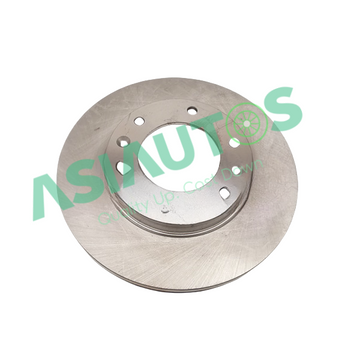
The braking system is the lifeline of a vehicle's safety systems. For the MAXUS/LDV G10, a commercial and family-friendly MPV, its core braking components—the front brake disc, front brake caliper, front brake pads, and vacuum booster—are crucial for safe driving. These seemingly insignificant components work together meticulously every time the brake pedal is depressed, converting the vehicle's kinetic energy into heat energy for smooth deceleration or stopping.
Front brake disc: the “revolving stage” of the braking system

The front brake disc is the component in the braking system that comes into direct contact with the brake pads. It is disc-shaped and typically mounted on the vehicle's front wheel hub, rotating with the wheel. The G10's front brake disc is made of cast iron, a material with excellent thermal conductivity and wear resistance. This allows for rapid heat dissipation during frequent braking, preventing the degradation of braking performance caused by high temperatures
Structurally, the G10's front brake discs are mostly ventilated. The disc body has evenly distributed ventilation channels, allowing air to flow through these channels during driving or braking, accelerating heat dissipation. This design is particularly important for MPVs, as their heavier bodies generate more heat during braking. Ventilated discs effectively maintain braking system stability.
The operating principle of the front brake disc is simple: when the driver depresses the brake pedal, the brake caliper clamps the brake pads against the rotating disc, and the friction between the two forces the wheel to slow down. The surface flatness and wear condition of the brake disc directly affect the braking effect. If grooves or deformations appear on the surface, it will cause abnormal noise and vibration during braking, and even affect the braking distance. Therefore, regular inspection and maintenance are required.

Front brake caliper: the “actuator” of braking action

The front brake caliper is a clamp-shaped component fixed to the axle. Its core function is to push the brake pads into contact with the brake disc. The G10 uses a floating caliper, a design that allows the caliper to slide axially relative to the brake disc. During braking, the inner piston pushes the inner brake pad into contact with the disc first. The caliper then moves the outer brake pad inward under the reaction force, ensuring even clamping of both brake pads on the disc.
The caliper housing is typically made of aluminum alloy or cast iron and contains a piston and seals. The piston is pushed by hydraulic fluid, and its surface is precision-machined to ensure smooth movement under the action of the hydraulic pressure. The number of pistons in the G10's caliper varies depending on the vehicle configuration, with most models featuring a single or dual-piston design. A greater number of pistons ensures more even contact pressure distribution between the brake pads and the disc, resulting in more stable braking.
To enhance durability, the caliper surface undergoes an anti-corrosion treatment, such as painting or electroplating, to resist erosion from rain, mud, and other factors. At the same time, the brake caliper is also equipped with an air bleed valve to discharge the air in the brake system. If air is mixed into the system, the brake pedal will become soft and the braking effect will decrease. Regular bleeding is an important part of maintaining the performance of the brake system.

Front brake pads: the “core medium” of friction braking

The front brake pad is the component that directly generates friction in the braking system. It is installed inside the brake caliper and consists of a steel back, a friction material layer and a silencer. The friction material of the front brake pad of the G10 adopts a semi-metallic or ceramic formula: the semi-metallic formula uses metal fiber as the base material and is mixed with friction modifiers. It has the characteristics of high temperature resistance and strong braking force, and is suitable for heavy load or frequent braking scenarios; the ceramic formula uses ceramic fiber as the main component, which has low noise and less dust during braking, better comfort, and less wear on the brake disc.
The steel back of the brake pad plays the role of fixing the friction material, and the surface is usually coated with an anti-rust layer. The silencer is attached to the back of the steel back, which can effectively absorb the vibration generated during braking and reduce abnormal noise. It is worth noting that there is a wear limit mark on the brake pad. When the friction material is worn to the same level as the mark (usually less than 3 mm thick), it must be replaced in time, otherwise it will cause a sharp decrease in braking effect or even damage the brake disc.
In daily use, the wear rate of the brake pad is closely related to driving habits. Frequent sudden braking will accelerate wear, while smooth driving can extend its service life. As an MPV, it is recommended that the brake pad thickness of the G10 be checked every 30,000 kilometers to ensure that it is in normal working condition.

Vacuum booster: "Power amplifier" of the brake pedal

The vacuum booster is a key component that connects the brake pedal and the brake master cylinder. Its function is to use the vacuum generated by the engine intake manifold to amplify the driver's pedal force, making the braking operation easier. For the heavier G10, the vacuum booster is particularly important - without it, the driver needs to use more force to achieve the same braking effect, and is prone to fatigue during long-distance driving.
The core structure of the vacuum booster is a sealed diaphragm chamber, which is divided into a front chamber (connected to the atmosphere) and a rear chamber (connected to the engine intake manifold to form a vacuum). When the brake pedal is pressed, the push rod pushes the diaphragm, causing the vacuum in the rear chamber to change. The atmospheric pressure pushes the diaphragm to drive the piston of the brake master cylinder to move, thereby amplifying the braking force. Its boosting effect can usually reach 2-3 times the driver's pedal force, greatly reducing the operating intensity.
The vacuum booster of G10 is also equipped with a one-way valve and a vacuum energy storage tank. The one-way valve prevents the loss of vacuum, and the energy storage tank retains a certain vacuum when the engine suddenly shuts down, ensuring that there are still 1-2 effective brake boosts, improving safety in emergency situations. If the vacuum booster fails, the brake pedal will become hard and the braking distance will become longer, which requires immediate maintenance.

The coordination of these four components constitutes the core of the G10 front brake system: the driver steps on the pedal → the vacuum booster amplifies the force → the brake master cylinder generates hydraulic pressure → the brake caliper piston pushes the brake pad → the brake pad clamps the rotating brake disc → the vehicle slows down. The whole process is completed in milliseconds and relies on the precise coordination of each component.
In daily maintenance, in addition to regularly checking the wear of the brake pads and brake discs, you also need to pay attention to the state of the brake fluid - the brake fluid is hygroscopic, and long-term use will cause the boiling point to drop. At high temperatures, it is easy to produce air blockage, which affects the braking effect. It is recommended to replace it every 2 years or 40,000 kilometers. At the same time, if abnormal noise, deviation, abnormal pedal rebound, etc. are found during braking, it is necessary to check in time to avoid safety hazards caused by component failure.
As the main model in the MPV market, the design of the brake system components of the G10 fully considers the needs of heavy load, comfort and safety. These seemingly simple metal and rubber components have built a solid safety barrier for every trip through continuous technical optimization. Understanding their working principles and maintenance points can help car owners better protect vehicle performance and make every journey worry-free.
Your reliable supply partner for MAXUS/LDV G10 auto parts


